



Above, you’ll find my reading of the eighth case in The Record of Going Easy without annotations (thanks go to Martin Kaku’on for editing the recording). You’ll find annotations below in the text version of the full case, explaining the terms that are in need of explaining and identify the various Zen masters.
If this is your first time here for a full case, and as a reminder to those of you who are making a return visit, The Record of Going Easy was compiled by the renowned Hóngzhì Zhēngjué (1091-1157; referred to as Tiāntóng in this text) who also wrote a verse for each case. The introduction, commentaries, and capping phrases were written by Wànsōng Xíngxiù (1166–1246). Both were great teachers in the Cáodòng/Sōtō lineage of Zen. Below, the capping phrases are indented and italicized.
The translation and annotations are my work - so the buck stops here for errors, misconceptions, and all manner of misses.
Below, you will also find easy access to my interview with David Dae An Rynick Roshi about this case as well as my brief commentary.
Comments and questions are welcome.
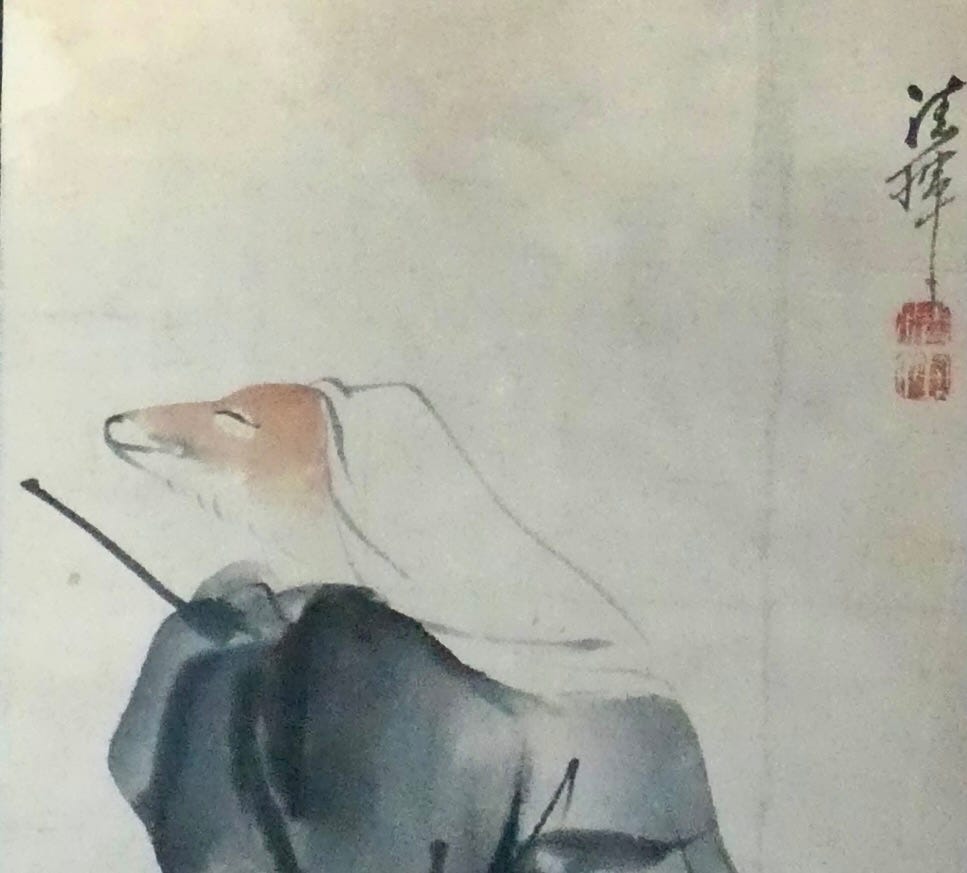
Case 8: Bǎizhàng’s Wild Fox
Presenting to the assembly, saying:
Hang on to the tiniest letter in the mind and you enter hell as fast as an arrow. Even a little wild fox slobber, when swallowed, can’t be vomited out for thirty years. It’s not that the imperative from the Western Paradise was strict, only that the stupid guy’s karma was heavy.1 Who is the one who transgressed in the past?
舉
When Bǎizhàng went up to the hall, there was always an old man listening to the dharma. Then the old man would follow the crowd out as they left.
Within noise, finding quiet.
One day, he did not go out.
Always had my suspicions about this guy.
Bǎizhàng asked him, “Who is the person standing here?”
Handing over the matter he doesn’t understand, but when a guest comes, they must be
dealt with.
The old man said, “In the past, in the time of Kāśyapa Buddha, I lived on this mountain.
Originally, it’s one family.
A practitioner asked me, ‘Does a person of great practice still fall under karma or not?’2
Just do good, don’t ask about the road ahead.
I answered them, saying, ‘They don’t fall under karma.’
Saying one fitting sentence ties you to a donkey stake for numberless kalpas.
With this, my body turned into a wild fox for five hundred lives.
But you said, “They don’t fall under karma.”
Now I ask you, Venerable, please say a turning word for me.”
Why?
Bǎizhàng said, “They don’t obscure karma.”
Nevertheless, buried in the same pit.
At these words, the old man greatly awakened.
It’s just fox slobber.
The teacher [Wànsōng] said,
Every time Zen Master Dàzhì of Hóngzhōu’s Bǎizhàng mountain would ascend the seat, an old man would come and listen to the dharma.3 During the time of Kāśyapa Buddha, he lived on this mountain.4 Because he gave a mistaken turning word to a practitioner, he fell into the body of a wild fox. For the very reason that he had leaned on a fence, he caused others to stick to walls, sending them off to fall into pits and chasms. Seeing how Bǎizhàng had a method for pulling out nails and drawing out wedges, the former Bǎizhàng was ready to follow him. He asked Bǎizhàng for a substitute turning word. Bǎizhàng shared his explanation with no fear.
Bǎizhàng gently blocked the detour with “They don’t obscure karma.” At these words, the old man greatly awakened. This is according to the facts and the commentaries. See how “Not falling under” is set aside, not cut off. “Not obscure karma” is to follow the flow and realize the wondrous. A little separation and you’re off to the races. Uphold it and see. You might want to peel off your fur, but you’ll find that you are still covered with fish-scale armor.
Haven’t you heard that Zen Master Dàoyuán was in the assembly at Zen Master Nán’s place?5 Two monks were raising this story. One monk said, “If it’s only ‘not obscuring karma,’ why have they not yet shed their wild fox body?”
The other monk said, “This is precisely ‘not falling under karma.’ Did they ever fall into a wild fox body?”
The Master shivered when he heard this dialogue and immediately left to go to a Green Jade Hermitage on Huángbò Mountain. As he crossed a stream, he greatly awakened. He returned and as he told Master Nán what had happened, tears rolled down his face and over his chin. Master Nán told him to warm himself on the attendants’ couch and get some rest.
Dàoyuán suddenly woke up and composed this verse:
Not falling under, not obscuring.
Originally, for monastics and householders, there were no taboos.
An ordinary person’s breadth of mind is the same as the king’s.
Strive to receive the purse with the hidden cover.
One staff accepts being used vertically or horizontally.
A wild fox leaps into the company of golden lions.
Master Nán belly laughed. What’s that about?
If, when the old man asked the Venerable Bǎizhàng for a substitute turning word, he had instead just delighted in “not falling under karma,” he would have avoided causing the monks’ beginner’s minds to degenerate in the pit of liberation.
Bǎizhàng arrived back at the monastery in the evening and went up to the main hall, sharing the earlier chain of karma. Huángbò then asked, “The old man gave a mistaken turning word and was reborn in a wild fox body for five hundred lives.6 Instead, what if he had just rolled along with no mistake. What would have happened then?”
Bǎizhàng said, “Come close and I’ll tell you.”
Huángbò came close and struck Bǎizhàng with an open hand. Bǎizhàng clapped his hands, laughed, and said, ”You got me! I thought only a fox was red, but here is another red fox.”7
Yǎngshān said, “Bǎizhàng had great capacity. Huángbò had great function. Their fame was not falsely attained.”
Guīshān then asked Yǎngshān, “Huángbò always used this functioning. Was it due to his original state naturally realized or owing to some other person?”8
Yǎngshān said, “It is a gift received from his teacher and also by realization of self nature.”9
Guīshān said, “So it is. So it is.”
See how the parent, Bǎizhàng, and offspring demonstrated no fear as master and sovereign. How they turned toward the wild fox den to make a living.
I, Wànsōng, also have a tailbone that is completely exposed. I’ll leave it to Tiāntóng to play with his claws and teeth. Look!
Verse
One small wave, one big wave.
Fortunately, by themselves the Yellow River clears, the sea calms.
Five hundred lives endured in vain.
If one had only known earlier - today he regrets being reckless in the past.
Not falling under, not obscuring, they haggle!
The vile slobber is unceasing.
Still dashing into a nest of entangling vines.
Entangled from the waist down.
Heh heh heh!
Can laugh, can grieve.
Yes! Yes!
Pressing the ox’s head down to eat grass.
If you are pure and unattached,
This is like worms and maggots protecting trees.
You’ll sound like children playing, “‘Duō duō hé hé.”10
As it is occasionally written,
Surely the spirits will sing, the gods of the land will dance!
Keeping the rhythm is allowed.
Sing! Clap your hands!
The future is dust.
The teacher [Wànsōng] said,
Establish cultivation and verification and distinguish karma.11 “One small wave, one big wave.12 Five hundred lives endured in vain.”
Before Dàoyuán went to Green Jade Hermitage, those two monks must have been having an outstanding back-and-forth discussion.
When we carefully check Tiāntóng’s expression, “Still dashing into a nest of entangling vines,” we find that this sentence has two characters that are not in harmony. In light of the koan, why not say, “... run into a wild fox den”?13
“Heh heh heh.”
This clearly praises Bǎizhàng‘s state of awakening. Tiāntóng exposes his one heart with “Yes! Yes!” Still, you should inquire if Tiāntóng has understood.
“If you are pure and unattached,/You’ll sound like children playing, ‘Duō duō hé hé.’”
Fortunately there is a single shady place. Why try hard if not for others? “Duō duō hé hé” is baby talk and not the real thing. In Zhànrán’s Explanation of the Profound Meaning of the Lotus it explains, “‘Duō’ is a sound a toddler makes while learning how to talk.14 Puffing ‘hé’ is a common vocalization.”
In the Nirvana Sutra it says that the practice to cure a baby’s illness is for the grandmother to say, ‘hé hé’.”
Zen Master Shíshì Shàndào said, “Of the Nirvana Sutra’s sixteen practices, “baby conduct” is the best.15 Saying someone is ‘duō duō hé hé’ describes the study of a person of the Way who has abandoned the mind that distinguishes accepting and rejecting. This goes together with “Surely the spirits will sing…” all with full devotion!
Yet say, what is the melody?
Listen to the ten thousand sounds with mind and you will not hear.16 On a solitary precipice with no ears, you return to the intimate friend.17
Western Paradise refers to what we now think of as India.
Great Practice, 大修行底人 (Japanese, dai shugyō), DDB: “A person who has accomplished the great practice and attained awakening.”
karma, throughout this case, is the translation of 因果 (Japanese, inga), also known as “cause and effect.” DDB: “[...] The notion of cause and effect is essentially synonymous with that of karma. Buddhism also takes a distinctive approach to the matter of individuated causality by asserting that causes and effects span across separate lifetimes, a notion examined in detail by the Yogâcāra school, which explained individuated causality as operating through the ālayavijñāna. In Buddhism, it is also important to understand that the law of cause and effect is flawless—nothing gets by. If there is a cause there must be an effect and vice versa. All phenomena in existence arise, change, and cease according to the law of cause and effect.”
Baizhang Huaihai (720-814), a ninth-generation successor in China through Mazu.
Kasyapa Buddha, 迦葉佛, DDB: “He is the buddha prior to Śākyamuni and the sixth of the seven past buddhas. He is also the third of the thousand buddhas of the present bhadra-kalpa [...].”
Daoyuan, (nd), could refer to the compiler of Records of the Transmission of the Lamp. As for Zen Master Nan, there are many possibilities and insufficient clues in the text.
Huangbo Xiyun (d. 850), a tenth-generation successor in China of Baizhang Huaihai.
This version varies from that in the No Gate Barrier where Baizhang says, “The Barbarian had a red beard, and here’s a red-bearded barbarian.” 胡, barbarian, is replaced here with 狐, fox. Both are pronounced hú in Chinese.
Guishan Lingyou (771–853), a tenth-generation successor in China through Baizhang Huaihai.
Yangshan Huji (803-887), an eleventh-generation successor in China through Guishan.
Duō duō hé hé, 哆哆和和, similar to “Ta, ta, da, da” - sounds of small children. See below for a more thorough explanation.
Cultivation and verification, 修證, Japanese, shusho, more commonly translated as “practice and enlightenment.”
One small wave, one big wave is an idiom meaning “making a mountain out of a molehill.”
Wansong prefers “wild fox den,” rather than Tiantong’s “entangling vines.” Perhaps because the former is more in line with the koan or perhaps due to rhyming considerations that are beyond my skills to discern.
Zhanran (711–782), DDB: “The sixth Tiantai ancestor [...]. After Zhiyi, Zhanran is considered to be the most influential figure in formulating the Tiantai system of doctrine and practice.” Explanation of the Profound Meaning of the Lotus is Zhanran’s commentary on Zhiyi’s The Profound Meaning of the Lotus Sutra. In the text, according to DDB: “Zhanran argues for definitive Tiantai positions against those of major competing traditions [...].”
Yunyan Tancheng (780-841; aka, Tanzhou Shishi Shandao), a tenth-generation successor in China through Yueshan in the Shitou succession.
with mind, 有心, DDB: “The mind with a view of something to be grasped or attained.”
intimate friend, 知音, There is a double meaning here. First, DDB: “Someone who deeply understands and appreciates a certain musical composition, a certain composer, or musician. It comes from a story in the Liezi about a master lute player named Pai Ya whose music was deeply appreciated by his friend Zhong Ziqi. When Zhong suddenly passed away, Pai Ya destroyed his lute and gave up playing. The term has come to refer to an intimate friend who understands oneʼs inner mind. By further extension, in Chan, a metaphor for mind-to-mind communication, not needing words.” Second, if the two characters are read individually, then they could be rendered, “to know the sound of Buddha’s voice.”


