


Zen is like taking a shower. First, you wash with soap. Then you wash off the soap. The soap represents the process of cleaning up with the precepts, establishing a deeply settled body-mind (aka, samadhi), and tasting the truth of Buddha’s world (aka, kenshō, an initial awakening).
Washing off the soap represents the post-awakening process. It is also referred to as the removing the stink of Zen - including the post-awakening floral bouquet-like scent (as if walking into a room smelling of roses).
One of Katagiri Rōshi’s teachers in this phase of his training was Yokoi Roshi. While he was with Yokoi Roshi, Dainin-san felt that his life, his sense of himself, was shrinking and that he might disappear. He felt like he was suffocating. One day Dainin-san asked Yokoi Roshi why he never praised, only scolded. Yokoi Roshi said, “I scold you so that you might become a normal person.”
Another way of viewing the two illness comes from Fóyǎn who said, “The first illness is riding a donkey, seeking a donkey. The other illness is riding a donkey, refusing to dismount.”
And to continue wantonly mixing metaphors, recuperating from an illness caused by the medicine is no small thing.
“Case 11: Yúnmén’s Two Illnesses” points to the profound, meticulous rigor of the Zen Way, which truly flies in the face of most contemporary “Zen” assurances that your life just as it is, is it. Well, of course, on the one hand, it is. But to realize it and then thoroughly digest this truth (aka, wash it off), may well require that an aspiring student make major changes to their lives — especially if one’s “life as it is” is over-full with work, family, and leisure activities (including social media scrolling for hours a day).
That said, the previous two kōans that we’ve worked through here have been unusual in how provocative (the cat kōan) and subtle (the old woman of Táishān) they are. Case 11 is unusual in that most kōans feature an interaction between a teacher and a student (or a teacher and a cat … as the case may be). Here we have a teaching from Yúnmén with no explicit interactions.
This kōan is about the ongoing process of awakening, the interaction of awakening on ongoing delusion.
Here it is:
舉
Great Master Yúnmén said, “When the light has not penetrated and dropped off, there are two kinds of illness. One is where everything is not clear and before you there is something. The other is penetrating the emptiness of all dharmas, but vaguely there seems to be an object. This too is the light having not completely penetrated and dropped off. Again, the dharma body also has two kinds of illness. One illness is receiving the dharma body as the dharma, holding it and not forgetting, seeing it as if it exists. This is to fall on the side of the dharma body. Another is even though having passed straight through, you cannot let go. Next, carefully, attentively examine one-by-one. What breath is this? This too is exactly illness.”
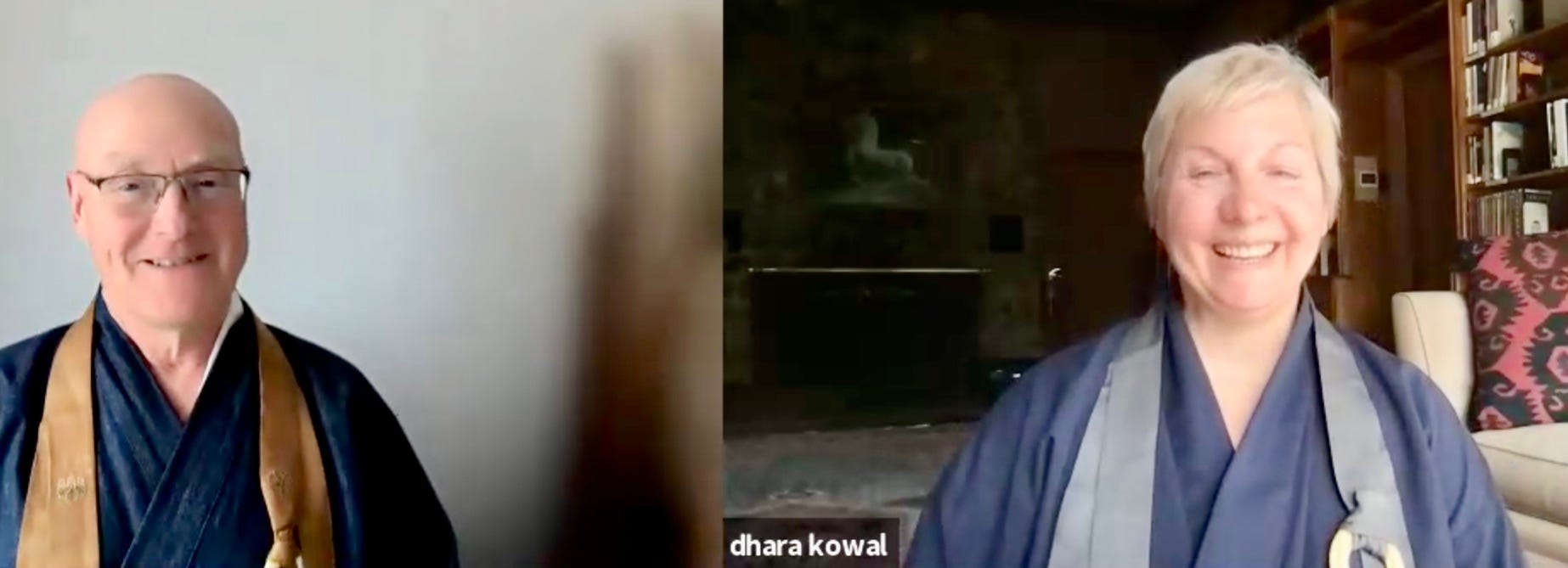
In order to further dig into this case, I spoke with Dhara Kowal Sensei, a dharma successor to Bodhin Kjolhede Rōshi in the Phillip Kapleau lineage. Dhara Sensei serves as Co-Director of the Rochester Zen Center. Dhara Sensei sums up the case like this: “Beware of duality!”
I will share the full interview here soon.
As mentioned, Case 11 features the teaching of one of the Zen greats, Yúnmén (864-949). Who was Yúnmén? Among many other things, he was a thirteenth-generation successor in China through Xuěfēng. After Yúnmén’s awakening and Xuěfēng’s death, he travelled widely and with the help of several other great masters, kept washing off the soap.
But that doesn’t really tell us who Yúnmén was.
Yúnmén’s teaching is said to simultaneously cut off the myriad currents, cover heaven and earth, and follow the waves.
One day, Qiánfēng presented a similar teaching on the two (or three) illnesses, and said, “Bear in mind that there is a single opening going beyond.”
Yúnmén came forward and said, “It’s like a person inside a thatched hut - why don’t they know the matter outside the thatched hut?”
You might see Yúnmén right here in your thatched hut. And if you see Yúnmén here, you’ve met Yúnmén and yourself.
Next, completely wash that off.
I’ll close with Tiāntóng’s verse, something we’ll return to in Case 11 in full in a couple week:
Verse
The limitless tangle of all things allows for the extraordinary.
Freely penetrating-through-and-dropping hinders the eye.
Who has the strength to sweep out this garden?
What’s hidden in a person’s heart surely turns into feelings.
A boat crossing the river sideways is soaked with the blue-green autumn.
Oars enter the illuminated reed flowers, bright as snow.
An old fisherman immediately takes a perch on the line to market.
A single leaf flutters on a flowing wave.
All posts here are free and open to everyone. If you’d like to support the work that Tetsugan Sensei and I are doing, you are welcome to become a paid subscriber at our Ghost site, Vine of Obstacles Zen. Free subscriptions are available too. With a paid subscription you’ll not only have access to more content, receive invitations to our Sunday talks and One-Day Retreats, but you will know that you are supporting this work.
A single leaf flutters on a flowing wave.
Marvelous, simply marvelous.
“The limitless tangle of all things allows for the extraordinary.”
Thanks for this case, and for the Obstacle of Vines, allowing both ordinary and extraordinary practice simultaneously.
I look forward to the interview.