


With this post, we begin the cycle again.
First, I’ll offer my translation of an old case, Record of Going Easy, Case 15: “Yǎngshān Plants a Hoe,” and some brief comments with background on Yǎngshān and his teacher, Guīshān. I’ll also highlight one of the main issues in the case.
Coming soon, I’ll share an interview with Steven Mūgen Snyder Rōshi, a teacher in both Theravada and Zen (see more below). Then, after Labor Day break, I’ll share my translation of the case in full with the verse, commentaries on the kōan and verse, and capping phrases.
Here’s my translation of the main case, “Yǎngshān Plants a Hoe:”
舉
Guīshān asked Yǎngshān, “Where are you coming from?”
Yǎngshān said, “I’m coming from the central field.”
Guīshān said, “How many people are there in the central field?”
Yǎngshān planted the hoe firmly, crossed his arms, and stood still.
Guīshān said, “On South Mountain, many people are cutting thatch.”
Yǎngshān grabbed his hoe and left.
Wànsōng (1166–1246) expresses the above referenced main issue in his commentary:
“Master and disciple, one body of the Way. Parent and child seize the opportunity. The Guīyǎng lineage is a timeless example.”
Background
Yǎngshān (803-887) aroused the Way Seeking Mind at an early age and asked his parents if he could become a home-leaver (aka, a monastic). They refused and so he cut off two fingers to demonstrate his sincerity. With this, they allowed their eight-fingered son to leave home.
In a recent post over at Vine of Obstacles Zen, “Bring Me Your Mind And I Will Calm It For You,” Tetsugan Sensei and I wrote about Huìkě (487-593) cutting off his left arm (fingers included) to demonstrate his sincerity to Bodhidharma.
“We want to emphasize that we adamantly and unequivocally will not accept students hacking off a body part, including a left arm, for a koan demonstration. However, in order to undergo the liberative process, a student will need to cut off something near and dear—like their identification and attachment to themselves (aka, manas consciousness).
So, although I’m not endorsing Yǎngshān disarticulating two fingers, his earnestness for the Way is certainly refreshing.
The first Zen teacher that Yǎngshān trained under was Dānyuán (n.d.) who was the primary successor for National Teacher Zhōng (675-775). Zhōng had become a successor of the Sixth Ancestor, Huìnéng (638-713), when he was thirty-eight years old. By this time, Huìnéng was close to death, so he entrusted a secret document with 97 circle images depicting the Way to Zhōng. After Huìnéng died, Zhōng did a forty-year retreat on Elephant Bone Mountain.
Forty years, so from about 40-80 years old. He then began teaching and lived to 100.
As National Teacher, Zhōng was a seventh-generation successor in China while other lineages descending from other successors of the Sixth Ancestor were in their eighth, ninth, and even tenth generations. Because Zhōng was so close to the lineage source (aka, the Sixth Ancestor), many practitioners traveled to the capitol to test their clarity. So, there are many kōans that feature this National Teacher, so many, that Zhōng is often referred to as simply, “the National Teacher.”
Dānyuán, as I was saying, was a successor of National Teacher Zhōng and Yǎngshān’s first master. One day Dānyuán told the young Yǎngshān:
“The National Teacher transmitted the 97 circle images of the Sixth Ancestor. He had said to me, ‘Thirty years after my death, a novice monk will arrive from the south. He will see that this matter flourishes greatly.’ I have comprehensively examined this prophecy and see that it is you that it refers to.”
Dānyuán was sure that Yǎngshān was the monk who would fulfill the prophesy of the National Teacher. So, Dānyuán shared this deep, secret inheritance that came directly from the Sixth Ancestor of the text consisting of 97 secret circle images with Yǎngshān.
Yǎngshān took the images to his room, examined them, and then without consulting Dānyuán, he burned them up.
Sometime later, Dānyuán called Yǎngshān and said:
“The circle images that I transmitted to you should be kept as a deep secret.”
Yǎngshān said, “I already burned them.”
Dānyuán said, “Oh, son, even if you understood them, how about those who come after you?”
Yǎngshān said, “Venerable, if you wish, I’ll reproduce the text.”
Yǎngshān then reproduced the text and presented it to Dānyuán. There was not a single error.
So, that gives you a sense of the guy.
Sometime later, Yǎngshān went to Guīshān (771–853). Guīshān was a successor of great master Báizhàng (720-814). That’s the Báizhàng in the Wild Fox Kōan:
Bǎizhàng’s Wild Fox: "Does a Person of Great Diligent Practice Fall Under Karma?"

Welcome to the New Year at Shake Out Your Sleeves and Go!
Here’s how the meeting unfolded:
Guīshān asked Yǎngshān, “As a novice monk do you have a master or not?”
Yǎngshān said, “I have one.”
Guīshān said, “Who is it?”
Yǎngshān walked from west to east and then stood upright.
Guīshān realized that Yǎngshān was extraordinary.
Extraordinarily direct! Yǎngshān became Guīshān’s successor, an eleventh-generation master in China. Together, Guīshān and Yǎngshān are considered the founders of one of the five branches of Zen in China (aka, five petals on the one Zen flower), the house of Guīyǎng.
Guīshān and Yǎngshān are often cited as having the quintessentially intimate teacher-student relationship. Like Wànsōng said above, “Master and disciple, one body of the Way.”
When I reflect on Guīshān and Yǎngshān, I often think about my relationship with my first master, Katagiri Rōshi, and how it felt just serve him tea—one body of the Way. It was Katagiri Rōshi that first introduced me to a related kōan:
“Guīshān requested that everyone work in the field. Yǎngshān asked, “This place is low, that place is high.”
Guīshān said, “Water can level all things. Just let water level it.”
Yǎngshān said, “Water, too, is not reliable. Let the high place be leveled by the high place, the low place leveled by the low place.”
Guīshān said, “Right.”
Like the main case cited above, here we have Guīshān and Yǎngshān again working in the fields, playing with oneness and difference. That’s much like “the central field” and “cutting thatch.”
As for the main point, let the high place be high and the low place low. You might just sit quietly and reflect on this teaching now.
Among Yǎngshān’s successors was great master Miàoxīn (n.d.), one of the few known women masters of the Táng Dynasty. More about her here:

Coming Soon
“A Miraculous Journey: An Interview with Steven Mugen Snyder Rōshi”
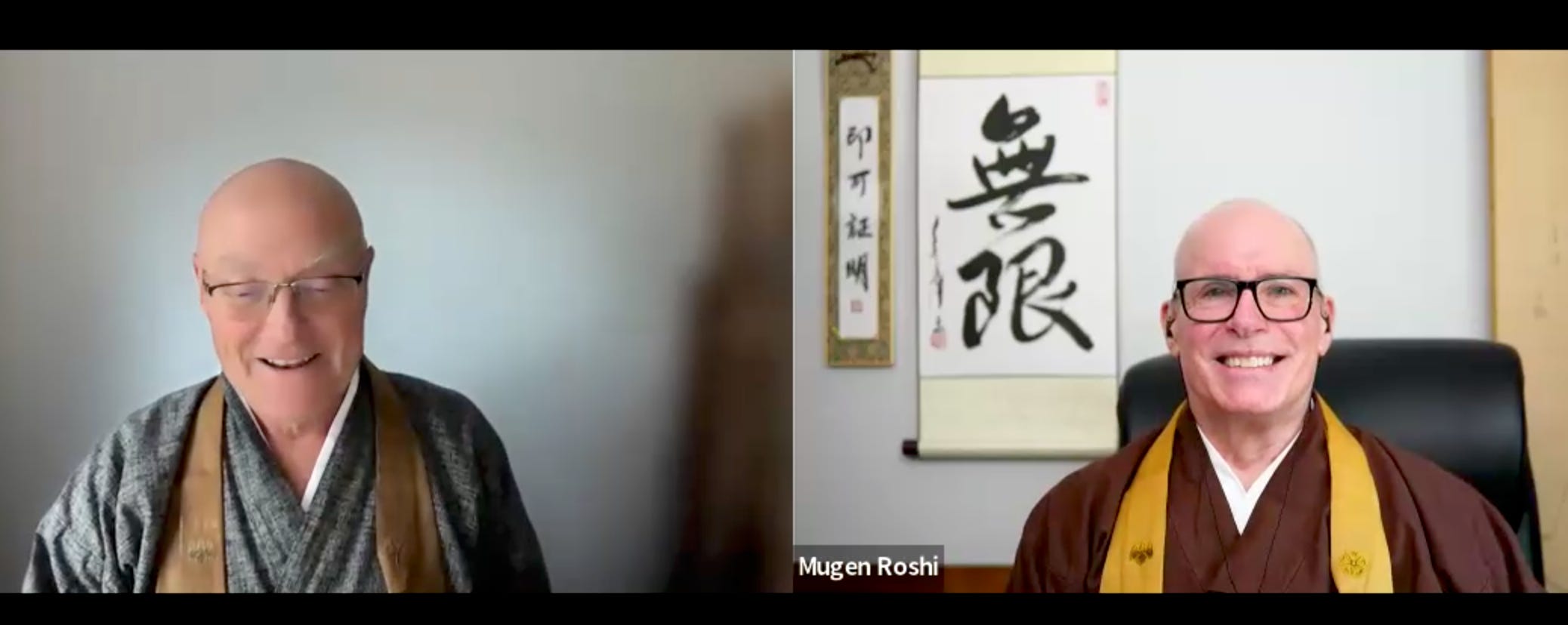
Mūgen Rōshi began meditation practice in 1976 after reading Three Pillars of Zen. Since then, he has practiced in the Zen, Tibetan, Theravada, and non-dual traditions. Mūgen Rōshi was authorized to teach in the Theravada Buddhist tradition in 2007 by Pa-Auk Sayadaw, an important Burmese dharma teacher, and in Zen in 2022 by Mark Sando Mininberg Rōshi. Mūgen Rōshi is a fully authorized teacher in the Glassman Rōshi branch of the White Plum Asangha. He is the founder of Awakening Dharma and the author of seven books, including Practicing the Jhānas: Traditional Concentration Meditation as Presented by the Venerable Pa Auk Sayadaw.