


Welcome to the New Year at Shake Out Your Sleeves and Go!
My intention for ‘26 is to post ten cases from The Record of Going Easy. That means thirty posts — ten introductions, like this one, ten interviews with kōan teachers, and ten of my new, original translations of the full case (i.e., an introduction by Wànsōng, the kōan with capping phrases by Wansong, a commentary on the kōan by Wànsōng, a verse by Tiāntóng [aka, Hóngzhì], capping phrases on the verse by Wànsōng, and commentary on the verse by Wànsōng).
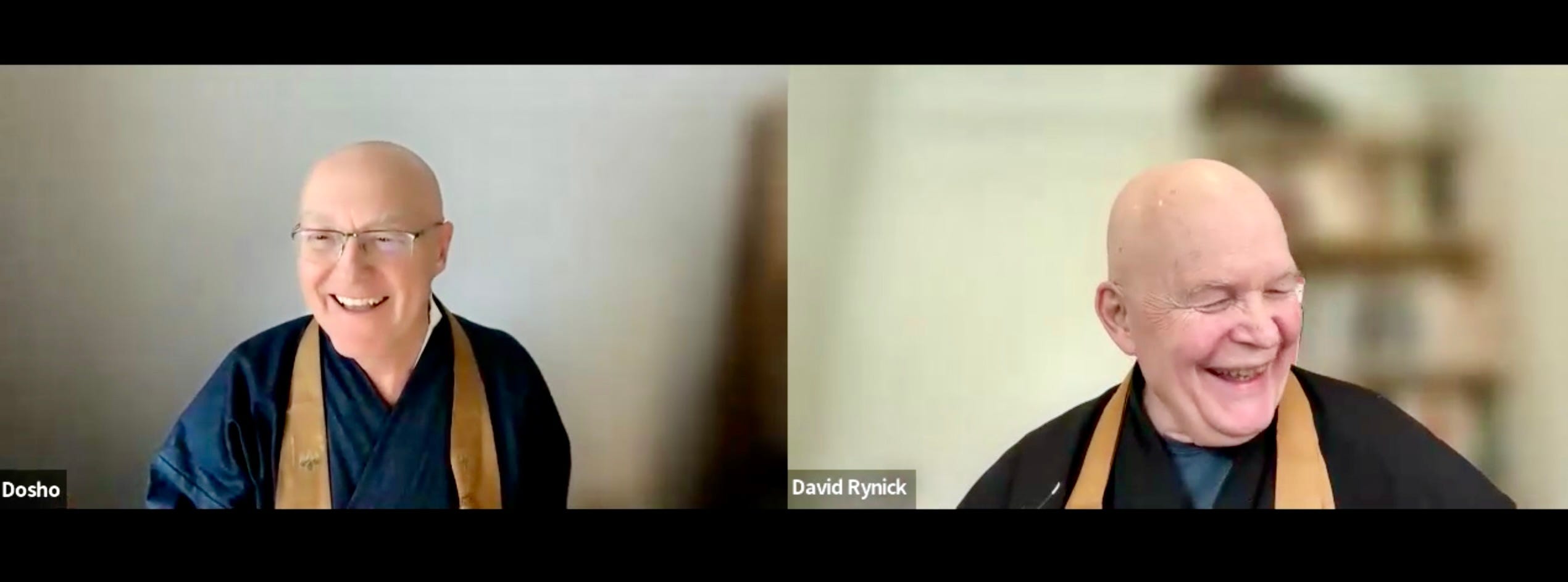
As for the kōan teacher interviews, I’ll continue to talk with teachers from a range of lineages and perspectives. First up will be David Dae An Rynick (pictured below) and “The Possibility of Meeting In Some New Way,” followed by Karin Ryuku Kempe.
Case 8: Bǎizhàng’s Wild Fox
So let’s get going with a kōan that’s well-known in Zen circles for its subtlety, Case 8: Bǎizhàng’s Wild Fox. And it is the subtlety that can draw a practitioner into a kōan. With this Wild Fox kōan, once you enter in earnest, “… you can check out any time you want, but you can never leave.”
There’s a good-sized dose of kōanic synchronicity with this being the next case up here at Shake Out Your Sleeves and Go given that Tetsugan Sensei selected “karma” as our theme for the year for our Vine of Obstacles Zen students. It’s as if we coordinate these things.
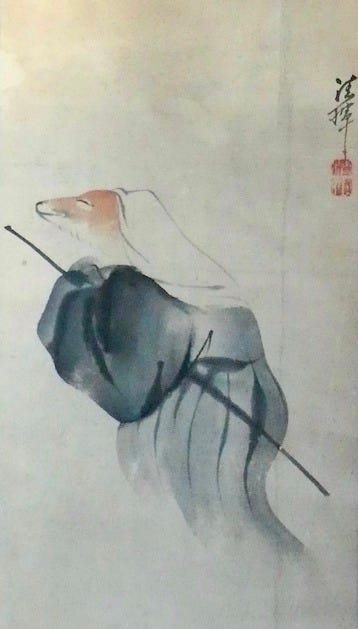
But when you’re dealing with wild fox, synchronicity seems to be the order of the day. And here at the Neyaashi Zen Hermitage, we’re dealing with wild fox on an almost nightly basis. There are several healthy-looking, bushy-tailed wild fox (not dressed as Zen priests as in the above image) who frequent the field behind us, sometimes accepting the offerings that we put out for them. Sometimes hanging out in the unseeable periphery of the forest and yapping eerily in the darkness.
In East Asia, wild fox have long been considered to be both divine and demonic, tricksters and transmogrifiers. They also can possess a person. A wild fox will often appear in some form other than a wild fox with the promise of fulfilling a person’s wildest dreams. It usually does not turn out the way the person expected. Just when it seems their desires will be finally satisfied, the fox’s true identity is revealed.
The Wild Fox kōan has the quality of a dream and has long captured the imagination of dreamer artists, like W. S. Merwin’s in his powerful “Fox Sleep” (Merwin was a student of Aitken Rōshi). And like the contemporary graphic artist Bart King and his Zen Zomics (King uses the Japanese name, so Hyakujo is Bǎizhàng, and the image below is from a segment of the story not included in The Record of Going Easy version of the case, but a nice detail nonetheless):

Steven Heine’s Shifting Shape, Shaping Text: Philosophy and Folklore in Fox Koan explores the cultural aspects of the Wild Fox kōan in Japanese literature and much more.
In the Harada-Yasutani kōan shitsunai (室中, aka, in-the-room teaching), a student will first gain entry through the Mu kōan, then will work through a couple dozen checking questions aimed at helping them put Mu to work. This is followed by a series of Miscellaneous Kōans, and then the student begins The No Gate Barrier (Japanese, Mumonkan). The No Gate Barrier begins with Mu, so the student takes it up directly again. Next they come up against Bǎizhàng’s Wild Fox.

Summary of the main case
A fox who looks like an old man shows up after a dharma talk and questions Zen Master Bǎizhàng (720–814). It turns out that the fox/man was a former teacher on this very mountain, and so would also have been named Bǎizhàng. Clearly, this dream kōan is about the confrontation of past and present, present and past.
Long ago, while the former Bǎizhàng was teaching, a monk asked if a person of great diligent practice falls under karma or not. Because of his answer — not — the former Bǎizhàng was reborn as a wild fox (or “feral fox” as the character 野 could also be rendered) for five hundred lives.
Notably, the former Bǎizhàng gave what is arguably a correct answer. An arhat, by definition, does not give rise to habituated tendencies (aka, karmic impressions) after completing the practice. So for the practitioner of the individual vehicle, not falling under karma is the whole point.
And the great diligent practice of a bodhisattva is to transform their karmic consciousness into the Four Subtle Wisdoms and become buddhas. See Polishing a Tile to Make Four Subtle Wisdom Buddhas for more. In addition, Dōgen’s teacher, Rújìng, told him,
“As for those with karmic hindrances, when doing vigorous diligent practice, they certainly will be transformed.” (from Hokyo-ki).
Regardless of whether the former Bǎizhàng was right or wrong, they asked the present Bǎizhàng to say a turning word and free them from the body of a wild fox. The present Bǎizhàng does just that.
Take a look:
舉
When Bǎizhàng went up to the hall, there was always an old man listening to the dharma. Then the old man would follow the crowd out as they left. One day, he did not go out. Bǎizhàng asked him, “Who is the person standing here?”
The old man said, “In the past, in the time of Kāśyapa Buddha, I lived on this mountain. A practitioner asked me, ‘Does a person of great diligent practice still fall under karma or not?’ I answered them, saying, ‘They don’t fall under karma.’ With this, my body turned into a wild fox for five hundred lives. Now I ask you, Venerable, please say a turning word for me.”
Bǎizhàng said, “They don’t obscure karma.”
At these words, the old man greatly awakened.
If you’re familiar with the version of this kōan that appears in The No Gate Barrier, you’ll notice that there are two movements in that main case that are not included here in The Record of Going Easy. The first is what happens after the old man/fox is greatly awakened—he dies. But first he tells the present Bǎizhàng where to find his corpse—and he asks to be buried as a monastic. Dōgen had an issue with the present Bǎizhàng fulfilling that request, saying in Shobogenzo “Great Diligent Practice” (Japanese, Daishugyo):
“Do not groundlessly regard the transmogrification of a wild fox spirit as authentic and do not make light of the dharma standards of Buddha Ancestors. As descendants of Buddha Ancestors you should value the excellence of their dharma standards. Do not go along with such an inappropriate request as it appears Bǎizhàng did. A single matter, a single dharma, is rare to encounter. Do not be affected by worldly customs and human sentiments.”
Nevertheless, that part of the kōan does not appear in this version, so I’ll leave you with Dōgen’s issue, and move on.
The second movement of the main case from The No Gate Barrier that is not included in the main case here involves Huángbò giving the present Bǎizhàng a slap. You’ll find that in the commentary when I post this case in full. So, again, I’ll move on to Tiāntóng’s verse.

Tiāntóng’s verse
One small wave, one big wave.
Five hundred lives endured in vain.
Not falling under, not obscuring, they haggle!
Still dashing into a nest of entangling vines.
Heh heh heh!
Yes! Yes!
If you are pure and unattached,
you’ll sound like children playing, “‘Duō duō hé hé.”
Surely the spirits will sing, the gods of the land will dance!
Sing! Clap your hands!
Tiāntóng verse is of a surprisingly different tone than the kōan. He starts off by understating the issue of freedom from karma. “One small wave, one big wave” is an idiom meaning “making a mountain out of a molehill.”
Tiāntóng then suggests that there really is no difference, or no worthwhile difference, between not falling under and not obscuring. And yet, the former Bǎizhàng received five-hundred lifetimes as a wild fox, seemingly as the karmic effect of dismissing karma.
Dōgen, who calls Tiāntóng an old Buddha, has an issue with him here. In his Deep Faith in Cause and Effect (Jinshin inga 深信因果), Dōgen writes:
“We should clearly recognize that dismissing karma is inviting disaster. In past times, the ancient worthies all clarified karma; in recent times, the latecomers are all confused about karma. Even in today’s world, those who, with a pure mind of bodhi, would study the buddhadharma for the sake of the buddhadharma, should clarify karma just as the ancient worthies did. To say there is no karma — this is a view of other paths.”
Tiāntóng’s seems to be claiming just that — that “not falling under karma” and “not obscuring karma” are the same. This is exactly the kind of “dismissing karma” that Dōgen says invites disaster.
So is Dōgen right or is Tiāntóng right? Looks like neither is obscuring karma, that’s for sure. And old Buddhas get to be wrong sometimes and maybe even invite disasters, like five-hundred lifetimes as a wild fox.
The last six lines of Tiāntóng’s verse are a celebration. Laughing, singing, pure and unattached party time for persons of great diligent practice.
Wànsōng’s capping phrase at the end of the verse:
The future is dust.
As if to say, “Sober up. This shit’s serious.”
All posts here are free and open to everyone. If you’d like to support the work that Tetsugan Sensei and I are doing, you are welcome to become a subscriber at our Ghost site, Vine of Obstacles Zen. You’ll not only have access to more content, but you’ll receive invitations to our present Sunday talks, One-Day Retreats, and more. Thank you.
If you are inclined to be put through the paces of a highly structured program designed for householders, you might find that Vine of Obstacles Zen is just the right place. See 15 Reasons to Become a Vine of Obstacles Zen Student.
Hmm, I'm always confounded by this koan. Why would Baizhang have taken a dead fox pelt, buried it on the temple grounds, then invented this fantastic morality play? For that may I be reborn as a wild fox, free of the need to deal with these stories, truly a sign of how debased we are. Perhaps I could be reborn as a Cetacean having survived the extinction of Homo sapiens, not that I have a choice in the matter....
I guess in the US, it could be renamed the coyote koan...