


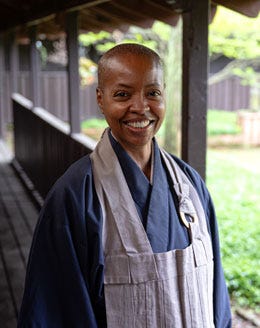
I recently had the opportunity to meet Steven Mūgen Snyder Rōshi and am happy that I did. We talked directly about combining Theravada and Mahayana practices (more about this below), reasons for Dogen’s apparent opposition to the form and formless absorptions (Sanskrit, dhyana; Pali, jhana), and about Record of Going Easy, Case 15: “Yǎngshān Plants a Hoe.”
Here’s some background information about Mūgen Rōshi:
He began meditation practice in 1976 after reading Three Pillars of Zen. Since then, he has practiced in the Zen, Tibetan, Theravada, and non-dual traditions. Mūgen Rōshi was authorized to teach in the Theravada Buddhist tradition in 2007 by Pa-Auk Sayadaw, an important Burmese dharma teacher, and in Zen in 2022 by Mark Sando Mininberg Rōshi. Mūgen Rōshi is a fully authorized teacher in the Glassman Rōshi branch of the White Plum Asangha. He is the founder of Awakening Dharma and the author of seven books, including Practicing the Jhānas: Traditional Concentration Meditation as Presented by the Venerable Pa Auk Sayadaw.
Regarding Mūgen Rōshi’s Practicing the Jhānas, I read it to prepare for the interview and found it excellent. In the interview, I said,
“I heartily recommend [Practicing the Jhānas], especially if you're a Zen person without background in Theravada or jhana practice. It will change what you think is possible in meditation.”
Returning viewers will find that I tried something different in this interview, using the kōan itself to provide the structure and suggest the questions for Mūgen Rōshi. I’ll be trying this approach again in my next interview with Jissai Prince-Cherry Sensei, teacher at the Louisville Zen Center, and one of the co-teachers for the Rochester Zen Center.
So stay tuned.
Here is Record of Going Easy, Case 15: “Yǎngshān Plants a Hoe.”
舉
Guīshān asked Yǎngshān, “Where are you coming from?”
Yǎngshān said, “I’m coming from the central field.”
Guīshān said, “How many people are there in the central field?”
Yǎngshān planted the hoe firmly, crossed his arms, and stood still.
Guīshān said, “On South Mountain, many people are cutting thatch.”
Yǎngshān grabbed his hoe and left.
I asked Mūgen Rōshi, about a tension I saw in teaching both Theravada and Zen (a Mahayana school). Specifically, I said, “The Theravada stresses breaking the wheel of rebirth, the Mahayana emphasizes transmuting the wheel—being reborn in the desire realm in order to facilitate the liberation of the living beings. Where are you coming from?”
He surprised me here:
Mūgen: “You can’t do both. Pa-Auk [Sayadaw] was very clear with me that if I was going to do the Theravada path, that I would at some point need to renounce the Bodhisattva Vow, and I would have to embrace the Theravada model […]. You couldn’t go beyond [a once returner], unless you were fully committed and had given up on the Bodhisattva model.”
Dosho: “What did you do?”
Mūgen: “I didn’t continue in the Theravada path. I had experiences there. But it was always clear to me that I was a Mahayanist.”
And I asked about householders attaining the same depth of practice as long-time homeleavers (aka, monastics). His response didn’t surprise me:
“I do think one has to have a very dedicated practice and they also have to work with a teacher closely. You can't do it on your own. You just can't see what you can't see. And we have our own biases as students that a keen-eyed and loving teacher can help us see and help us work with.”
My thanks go to Martin Kaku’on again for editing this recording.
I hope you enjoy the interview.
In case you missed my brief work-through of the case, you can find that here:


